
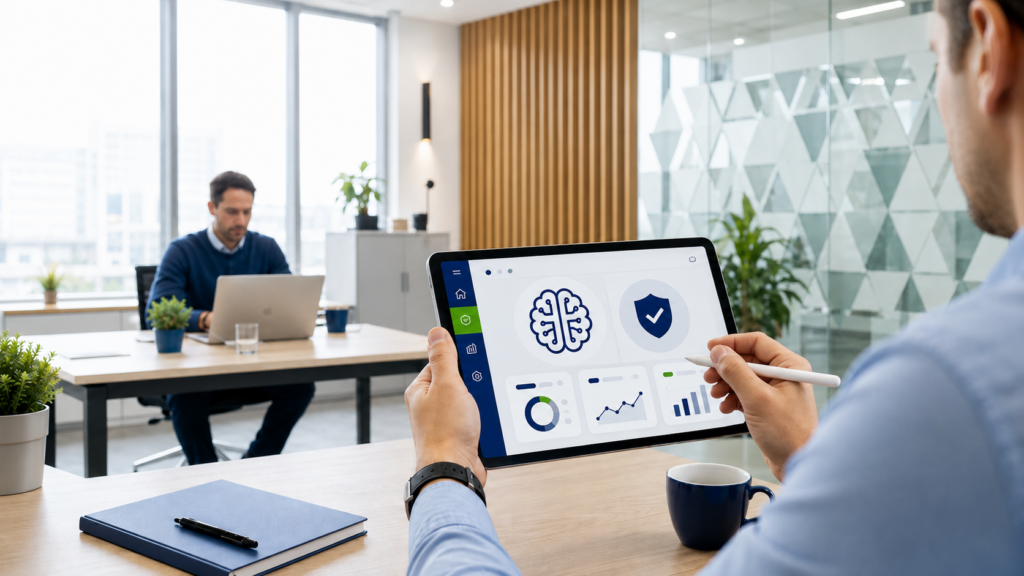
Managed AI: The Next Step in Modern IT GovernanceManaged AI: Der nächste Schritt moderner IT-Governance
Generative AI is rapidly transforming the workplace. Employees use ChatGPT, Claude and other AI tools to create content, analyze information and automate routine tasks. This increases productivity, but it also creates new challenges for IT departments.
Which AI applications are being used within the organization? What data is being transferred to external models? Who is allowed to create their own AI agents? And how can companies comply with data protection requirements, internal policies and the EU AI Act?
This is exactly where Managed AI comes in.Genau hier setzt Managed AI an.
For years, Mobile Device Management, or MDM, has enabled companies to centrally manage and secure smartphones, tablets and laptops. Managed AI applies the same governance principles to the use of artificial intelligence. The aim is not to restrict AI, but to make it securely, efficiently and responsibly available across the organization.
What Is Managed AI?
Managed AI refers to the centralized management of AI applications, AI models and AI agents within an organization.
Instead of allowing employees to use any AI service they choose, IT provides approved tools, defines permissions and creates transparency into how those tools are being used.
A Managed AI solution can help organizations:
- Centrally provide approved AI models
- Manage roles and access rights
- Securely integrate company-specific knowledge
- Comply with data protection requirements
- Document compliance measures
- Govern AI use across the organization
Managed AI therefore creates a binding organizational framework for the productive use of artificial intelligence.
Why Companies Need Managed AI Now
In many organizations, the adoption of AI is following a similar path to the introduction of mobile devices several years ago.
At first, numerous individual solutions emerge. Employees use different AI tools, test new applications or develop their own workflows, often without central coordination with IT.
This leads to familiar problems:
- Sensitive company data is entered into external AI services.
- Different applications comply with different security standards.
- Responsibilities remain unclear.
- Compliance requirements are difficult to demonstrate.
- Company knowledge becomes distributed across numerous isolated solutions.
centralized governance becomes.
Managed AI Applies an Established Governance Principle
As smartphones and tablets became increasingly common in the workplace, companies faced a new governance challenge.
Devices had to be securely configured, applications had to be distributed in a controlled manner and corporate data had to be protected without unnecessarily limiting employee flexibility.
Mobile Device Management provides an established governance framework for these requirements. Devices can be centrally administered, security policies can be consistently enforced and business data can be specifically protected.
The use of generative AI now presents a comparable challenge, but at the level of applications, models and data flows.
Even a technically secured smartphone or laptop cannot prevent sensitive information from being entered into an unauthorized public AI service. Securing the endpoint alone is therefore no longer sufficient.
Managed AI expands existing governance and security concepts to include the controlled provision and use of artificial intelligence. This enables companies to define which AI services may be used, who may access them and which data protection and compliance requirements apply.
Managed Devices and Managed AI Pursue the Same Goal
Mobile Device Management and Managed AI address different tasks, but they are based on the same fundamental principle.
MDM ensures that endpoints are securely managed. Managed AI ensures that the use of artificial intelligence meets the same requirements for security, data protection and governance.
Together, the two approaches support:
- Centralized administration
- Role-based permissions
- Controlled application deployment
- Transparent compliance processes
- Consistent security policies
However, they are not a single system. They are two complementary disciplines within modern enterprise IT. While MDM manages the devices, Managed AI governs the secure use of artificial intelligence on those devices.
Small and medium-sized businesses can particularly benefit from this approach because existing governance processes can be extended to AI without having to create entirely new organizational structures.
What Companies Should Look for in a Managed AI Solution
Not every AI platform is suitable for professional business use. The following criteria are particularly important.
Flexible Model Selection
Companies should be able to decide which AI model is used for each specific use case. Options may range from powerful cloud-based models to European or locally hosted alternatives.
Role and Permission Management
Administrators, business departments and end users require different permissions. A professional Managed AI solution should be able to define these roles clearly and transparently
Data Protection and Compliance
Features such as the pseudonymization of sensitive data, transparent documentation and support for regulatory requirements help companies use AI securely and in accordance with applicable rules.
Simple Deployment
AI applications should be easy to provide to employees, regardless of whether they work on desktop computers or mobile devices.
A Practical Example: Combining Managed Devices and Managed AI
The partnership between Cortado Mobile Solutions and Aiverti demonstrates how the two approaches can complement each other in practice.
Cortado helps companies centrally manage their mobile devices. Aiverti applies the same governance principle to the use of artificial intelligence. The platform enables organizations to provide AI models, AI agents and AI applications in a controlled manner while addressing data protection and compliance requirements.
Both solutions operate independently and perform different tasks. A practical connection emerges when companies already manage their mobile devices with Cortado MDM.
Aiverti can be centrally deployed to these devices as a Progressive Web App, or PWA. This gives employees easy access to the approved AI platform. At the same time, IT can govern both the endpoints and the use of AI according to the relevant governance principles.
The value therefore does not come from a technical integration. It comes from a consistent strategy for creating a secure digital workplace. Mobile Device Management provides the foundation for secure devices. Managed AI extends that foundation by enabling the controlled use of artificial intelligence.
Conclusion: Managed AI Is Becoming an Essential Part of Modern Enterprise IT
The question is no longer whether companies will use artificial intelligence. The question is how they can make its use secure, controlled and sustainable over the long term.
Managed AI provides the organizational framework required to achieve this. Combined with Mobile Device Management, it creates a comprehensive governance strategy in which both endpoints and AI applications are managed according to clear policies without confusing their respective responsibilities.
Companies that align these two areas create the conditions for the productive, data-protection-compliant and scalable use of artificial intelligence.
The partnership between Cortado Mobile Solutions and Aiverti demonstrates how Managed Devices and Managed AI can effectively complement each other without making the two solutions technically dependent on one another.
Bring Managed AI and Mobile Device Management Together
Would you like to learn how secure device management and controlled AI use can be effectively combined within your organization? Schedule a personal consultation with the Cortado team. In a no-obligation discussion or individual demo, we will show you how to align your mobile and AI strategies and create a secure digital workplace.