
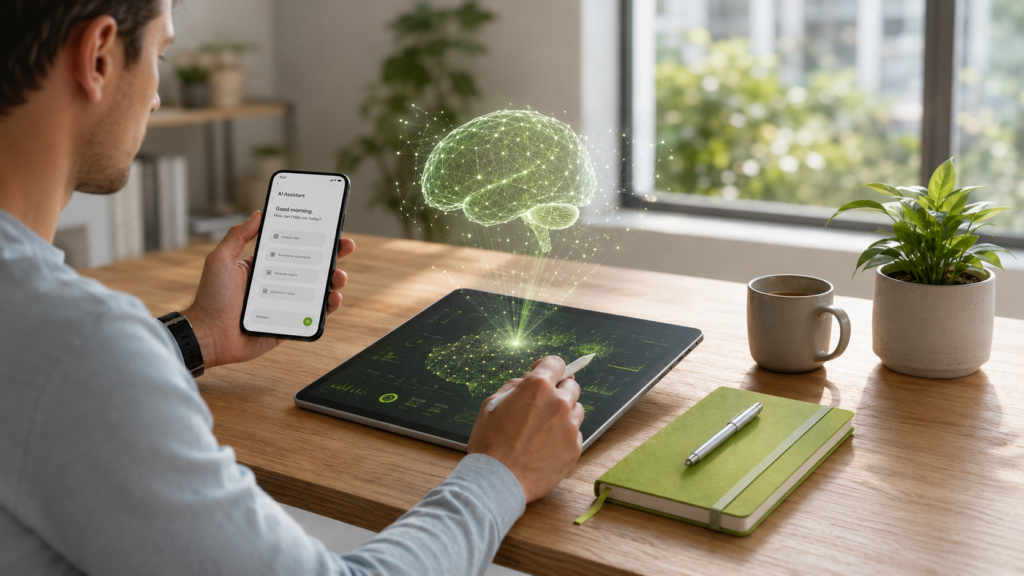
AI Adoption Has Already Begun, Often Without an Official Launch
A sales representative asks an AI assistant to summarize meeting notes after a customer conversation. A colleague in HR uses a chatbot to analyze job applications. Marketing teams are creating their first campaigns with generative AI, while the development department is testing its own AI agents.
Very few companies have officially introduced this type of AI use.
It has simply emerged.
Not because employees want to bypass rules, but because AI noticeably makes their work easier. Anyone who can save time or achieve better results with just a few prompts will use these tools, regardless of whether a company policy is already in place.
For IT departments, this fundamentally changes the situation. The question is no longer whether artificial intelligence is being used within the organization. The question is how its use can be made secure, transparent and compliant with data protection requirements.
Shadow AI Is the New Shadow IT
IT decision-makers are familiar with this pattern.
New technologies almost always spread faster than the processes designed to govern their secure use
A few years ago, the challenge involved private cloud storage, messaging platforms and file-sharing services. Companies had to learn that this new reality could not be managed through bans, but through clear governance.
The same pattern is now repeating itself with generative AI.
Whether they use ChatGPT, Claude, Gemini or specialized AI applications, employees often decide for themselves which tools to use for their tasks. This happens on company laptops, managed smartphones and personal devices alike.
The device itself is therefore not the problem.
The problem is that companies often do not know which AI tools are being used, which data is being processed or which rules apply.
This uncontrolled use is known as Shadow AI, a new form of shadow IT.
Why Bans Rarely Work
The initial response is often: block ChatGPT.
In practice, however, this does little to solve the underlying problem.
Blocking a service on the corporate network does not automatically prevent employees from using it. They may turn to alternative AI applications, access the service through a browser or use their smartphones instead.
AI does not disappear.
It simply disappears from the IT department’s view.
This creates new risks:
- Sensitive company data may be entered into public AI models.
- Different teams use different tools without common standards.
- Data protection and compliance requirements become difficult to track.
- Responsibilities remain unclear.
- Company knowledge becomes distributed across numerous isolated applications.
The real challenge is therefore not to “prevent AI,” but to “enable AI in a controlled way.”
Companies Must Now Address Two Governance Challenges
The modern digital workplace consists of two layers.
The first layer is the devices.
Smartphones, tablets and laptops must be secured, managed and kept up to date. Many companies already use Mobile Device Management, or MDM, for this purpose, while others are still introducing or evaluating suitable solutions
The second layer is the use of artificial intelligence.
Even the best-managed device cannot automatically answer questions such as:
- Which AI models may employees use?
- Which data may be transferred to external models?
- Who is allowed to develop their own AI agents?
- How can data protection requirements be met?
- How can AI use be documented in accordance with the EU AI Act?
This is where a Managed AI strategy comes in.
It complements device management with policies for the secure and transparent use of artificial intelligence.
Both areas pursue the same objective, but they address different tasks.
What Companies Need NowWas Unternehmen jetzt brauchen
Whether a company already uses Mobile Device Management is an important factor. At the same time, device management alone is no longer sufficient.
What matters is that both devices and AI applications become part of a shared governance strategy.
This includes, for example:
- Clearly defined roles and permissions
- Centrally managed security policies
- Controlled application deployment
- Transparency into usage
- Support for data protection and compliance requirements
Companies do not need to rethink every technology from the ground up. Many of the governance principles that have already proven effective for devices and applications can also be applied to the use of generative AI.
A Practical Example: Combining Device Management and Managed AI
The collaboration between Cortado Mobile Solutions and Aiverti demonstrates how device management and AI governance can complement each other. The two solutions have different areas of focus, but work together seamlessly in practice. While Cortado helps companies manage mobile devices, Aiverti provides an independent Managed AI platform that enables the controlled use of generative AI while taking data protection and compliance requirements into account.
The value lies precisely in combining these two approaches, even without a technical integration. Companies can use both solutions together or independently, allowing them to expand their governance strategy step by step. For a more detailed explanation of how Managed AI and Mobile Device Management work together, read our guide to Managed AI
Conclusion: Shadow AI Does Not Need Bans. It Needs Governance.
Generative AI will become as firmly established in companies as smartphones, cloud services and mobile applications.
The key question is not whether employees are using AI.
The question is whether companies are creating a clear framework for its use.
This requires two building blocks: secure device management and the controlled use of artificial intelligence. Depending on the company’s current situation, this may mean adding Managed AI to an existing MDM infrastructure or addressing both areas in parallel.
Companies that consider device management and AI governance together create the foundation for a modern digital workplace in which innovation and security are not mutually exclusive. They enable employees to use generative AI productively while maintaining visibility and control over data protection and compliance.
Bring Managed AI and Mobile Device Management Together
Would you like to learn how secure device management and controlled AI use can be effectively combined within your organization? Schedule a personal consultation with the Cortado team. In a no-obligation discussion or individual demo, we will show you how to align your mobile and AI strategies and create a secure digital workplace.